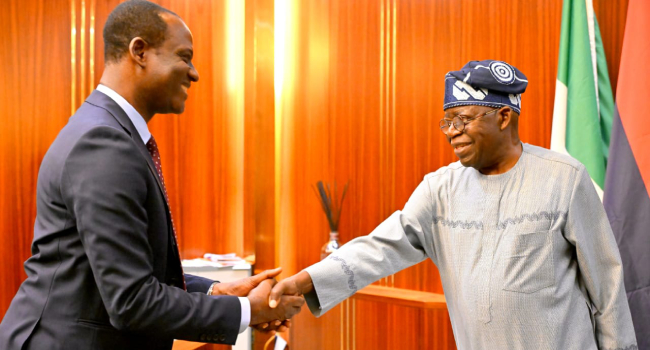
The afternoon sun cast long shadows across the marble floors of the Presidential Villa in Abuja on Monday as President Bola Ahmed Tinubu stood before a gathering of Nigeria's political elite, his voice carrying the weight of both ceremony and calculation. At precisely 2:30 p.m., inside the hushed confines of the President's office, Taiwo Oyedele—fiscal policy expert, tax reform architect, and now the nation's newly minted Minister of State for Finance—raised his right hand to take the oath of office, marking not merely a bureaucratic transition but a pivotal moment in Nigeria's ongoing struggle to stabilize its teetering economy. The brief ceremony, witnessed by top government officials and reported across Nigerian media from Channels TV to Punch Nigeria, carried symbolic resonance far beyond its abbreviated duration; here was a technocrat stepping into the crucible of power at a moment when inflation, though recently tamed to 15 percent, continues to squeeze the wallets of ordinary citizens, and when the administration's ambitious economic reforms hang in the delicate balance between political will and public patience.
Tinubu, watching the proceedings with the measured gaze of a leader acutely aware of the stakes, would later confess to those assembled that placing Oyedele within his cabinet required no deliberation, no agonizing over portfolios or second-guessing of qualifications—an admission that spoke volumes about both the President's confidence in his new minister and the urgency with which this administration views its fiscal restructuring agenda.
The Architecture of Reform: Taxation, Inflation, and the Dropping Gauntlet
What became immediately apparent during Monday's proceedings, as documented by Ripples Nigeria and TVC News, was the specificity of the mandate handed to the fifty-year-old Oyedele—a charge not merely to occupy an office but to fundamentally recalibrate the machinery of Nigeria's revenue generation. Tinubu, according to multiple sources present at the Villa, explicitly tasked his new minister with supporting efforts to strengthen fiscal policy and advance the administration's sweeping economic reforms, a directive that places Oyedele at the epicenter of the government's most consequential financial decisions. The President's praise for Oyedele's previous contributions to tax policy reform was neither casual nor ceremonial; rather, it underscored a strategic selection designed to inject technical expertise into a portfolio that demands both academic rigor and political dexterity. Business Hallmark reported that the appointment represents a calculated effort to enhance fiscal policy coordination, suggesting that Oyedele's arrival signals a potential shift toward more aggressive tax modernization—a critical imperative for a nation where revenue mobilization has historically lagged behind population growth and infrastructural demands.
With inflation having retreated to the 15 percent mark, according to data referenced during the ceremony, the administration appears to be leveraging this moment of relative monetary stability to push through structural changes to the tax code that previous governments have shied away from, changes that could redefine the relationship between the Nigerian state and its taxable citizenry.
The Human Calculus: Family, Sacrifice, and the Private Cost of Public Service
Yet beneath the formal protocols and policy pronouncements, Monday's swearing-in revealed the deeply personal dimensions of governance that often escape the ledgers and spreadsheets of fiscal analysis. In a moment of unexpected intimacy that was captured by Daily Trust and other outlets, President Tinubu turned his attention to Oyedele's wife, offering thanks for her support of her husband's decision to enter public service—a gesture that acknowledged the often-invisible sacrifices made by families when technocrats abandon lucrative private sector careers for the uncertain rewards of ministerial duty. This recognition of the familial infrastructure that sustains political leadership provided a counter-narrative to the cold mechanics of economic reform, reminding observers that behind every policy memorandum and revenue projection stands a human being negotiating the competing demands of public duty and private life.
Oyedelle's own decision to accept the position, which Tinubu described as making it a "very good day" for the nation, according to Channels TV, represents a significant personal wager; the President's earlier nomination of Oyedele on March 3rd to replace Doris Uzoka-Anite—who was subsequently redeployed to serve as Minister of State for Budget and National Planning—set in motion a cabinet reshuffle that reflects Tinubu's evolving strategy for managing Nigeria's economic portfolio.
The President's characterization of Oyedele as a "very dedicated and highly determined individual" was not mere rhetorical flourish but a recognition of the stamina required to navigate the treacherous waters of Nigerian fiscal policy, where reform efforts must contend with entrenched interests, bureaucratic inertia, and the ever-present specter of public skepticism.
The Senate's Seal: Confirmation Drama and the Mechanics of Power
The road to Monday's ceremony had been paved the previous week in the red-carpeted chambers of the Nigerian Senate, where Oyedele faced the legislative scrutiny that separates ministerial nominees from confirmed officeholders. As reported by multiple outlets including Daily Trust, the upper chamber confirmed Oyedele through a voice vote at the Committee of the Whole, following what sources described as hours of screening—a process that, while ultimately smooth, subjected the nominee to rigorous questioning about his vision for Nigeria's tax administration and fiscal future. This legislative imprimatur, though less visually dramatic than the Presidential Villa oath-taking, represented a crucial constitutional checkpoint in Oyedele's ascent to power, one that tested not only his technical competence but his ability to articulate complex economic concepts to lawmakers representing diverse constituencies with varying appetites for reform. The voice vote itself—a method that records collective assent rather than individual positions—suggested a broad consensus across party lines regarding Oyedele's qualifications, a rarity in Nigeria's often fractious political landscape and perhaps an indication that the imperative of economic stabilization has begun to transcend partisan divides.
The speed of the confirmation, coming merely days before Monday's swearing-in, indicated an administration eager to fill critical economic posts without the protracted delays that have historically hampered policy implementation, particularly as Nigeria navigates the turbulent aftermath of fuel subsidy removal and currency unification measures that have defined Tinubu's first year in office.
Future Implications: Between the Ledger and the Legacy
As Oyedele assumes his duties in the Ministry of Finance's complex on Lagos Island, taking up the portfolio recently vacated by Uzoka-Anite's transition to Budget and National Planning, the question that looms over his tenure is whether technical expertise can translate into political victories in a nation where economic reform has often faltered on the rocks of popular resistance. Analysts suggest that Oyedele's immediate challenge will involve harmonizing the administration's tax modernization agenda with the pressing need to expand the social safety net—a delicate balancing act that requires not only fiscal acumen but the communication skills necessary to convince skeptical Nigerians that broadening the tax base will ultimately fund the infrastructure and services that have long eluded them. The 15 percent inflation figure, while representing improvement from earlier peaks, remains a stark reminder that monetary policy and fiscal policy must work in concert if the administration's goal of economic recovery is to materialize; Oyedele's role in coordinating these efforts, particularly his involvement in reviewing Nigeria's tax system, will likely determine whether Tinubu's economic legacy is defined by structural transformation or by the social unrest that has historically greeted aggressive revenue mobilization in resource-dependent economies.
Moreover, the technocratic nature of Oyedele's appointment—his background as a policy expert rather than a career politician—suggests a wager by the Tinubu administration that Nigeria's economic challenges have reached a complexity that demands specialized knowledge over political patronage, a hypothesis that will be tested in the coming months as the minister attempts to navigate the intersecting pressures of international creditors, domestic revenue targets, and the insatiable demands of a population hungry for tangible improvements in their daily lives.
Whether Monday's ceremony in Abuja marks the beginning of a fiscal renaissance or merely another chapter in Nigeria's long history of unfulfilled economic promises remains to be written, but for now, the ledger is open, the calculations have begun, and a new minister holds the pen.
📰 Sources Cited
- Channels TV: You Fit The Bill, Tinubu Tells New Minister Taiwo Oyedele
- Ripples Nigeria: Tinubu swears in Oyedele as minister
- TVC News: PHOTOS: Tinubu Swears In Oyedele as Minister of State for Finance
- Daily Trust: Tinubu swears in Oyedele as Minister
- Business Hallmark: Tinubu swears in Taiwo Oyedele as minister of state for finance
- Punch Nigeria: PHOTOS: Tinubu swears in Oyedele as minister of state for finance
0 Comments
Sign in to commentNo comments yet. Be the first to share your thoughts!